We hit the streets after unpacking and soon realized graffiti we saw on our way from the airport is just part of Berlin’s charm.
Her brash and vibrant heart is welcoming to everyone. Our hotel, Adlon Kempinski, was centrally located to numerous museums, monuments, memorials and galleries displaying both the city’s dark past and bright future.
We have always been curious about Berlin. It once was the epicenter of one man’s madness. Thousands of young men like our fathers were drawn into battle and became brothers bonded in war to oppose that madness.
First Marine Division Corporal, Terry F. Harrison fought in the South Pacific on Peleliu and Iwo Jima in hand-to-hand combat. Air Force First Lieutenant, Ralph B. Herbeck, a bombardier, completed 25 missions in a B-17. Both men received numerous metals for their bravery. Both continued to love their country, but closed the door to conversation about their service. Each returned home to marry their sweethearts and raise families.
Some of the highlights from our visit included:
 Seated at a table for two on the second floor of our hotel we were afforded a prime view of Pariser Platz and Brandenburg Gate. The Quadriga, the statue atop the gate, was fancied by Napoleon. In 1806 when he conquered Berlin, the iron lady and horses were transported to Paris.
  The statue was returned to Berlin in 1814 upon his forced abdication. Today the gate, once behind the Berlin Wall, stands as a testament to the reunification of Germany.
 The Holocaust Memorial’s black granite slabs cover an entire city block. The irregular heights and shapes symbolize the innocent victims of intentional murder and cruelty. We walked through the memorial on three different occasions. Our first visit was in the early morning. In the center, the slabs towered over our heads and blocked the sounds of the city. Our second visit was in mid-day. We each took a different path to the center. All around us the laughter of children playing hide and seek echoed off the columns. Our last visit was at dusk.
  The fading sunlight created an eerie and foreboding environment as dark shadows fell on the bricks beneath our feet.
Many new government buildings are clad in glass symbolizing their transparent government. Hundreds gather each night from July to October on the banks of the River Spree opposite the Marie-Elisabeth Luders Building. 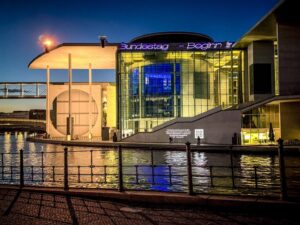 The walls are transformed into a gigantic film screen displaying a laser light show about the government procedure.
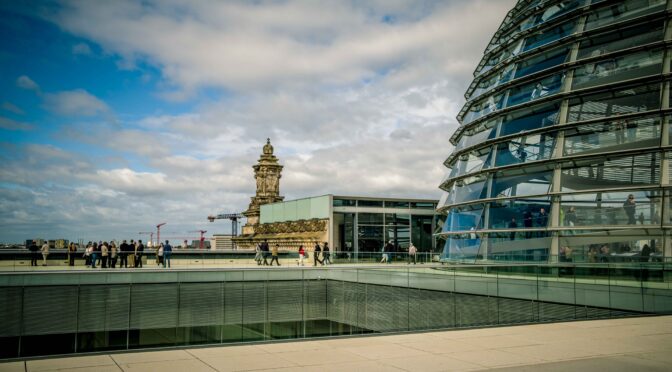
The reconstructed glass dome of the Reichstag Building is a marvel. We had a bird’s eye view of Berlin after climbing to the rooftop observation deck.
We joined Jeremy Minsberg for his excellent 5-hour walking tour. His knowledge of Berlin is extraordinary and brought the city to life.
We boarded a boat and gained a different perspective of Berlin by sailing the River Spree from Museum Island to Charlottenburg and back. We can’t attest to the nightlife. We are ready to call it a day around 9 or 10 pm. We are told the clubs sometimes go off the rails and parties last until the break of dawn.
 The East Side Gallery is the longest preserved piece of the Berlin Wall. We walked the 13-kilometers of the open air museum. When the original art work began to degrade, 87 artists from around the world restored 100 murals in 2009.
Checkpoint Charlie was on our list. A smaller replica was installed on the original site. The original Checkpoint Charlie was removed in 1990 to be displayed in the Allied Museum. It felt strange to see stands selling t-shirts and coffee mugs at a memorial where East Germans died in numerous failed escape attempts.
We traveled to Potsdam to visit Schloss Sanssouci, the summer palace of Fredrick the Great. His modest, single-story 10-room villa is built on the brow of a terraced vineyard.  This palace was Frederich’s idea of everyone’s wish to live without worry – sans souci.
We strolled down Unter den Linden into the heart of Museum Island. We explored the Alte Nationalgaierie, which has been open since 1876 showcasing three stories of 19th-century European art.
 Neither of us are much for shopping, however, we did window shop on a wide, tree-lined boulevard on our way to Potsdamer Platz which occupies an entire city quarter. Once divided by the Berlin Wall the central plaza is canopied by a towering glass roof that erupts in changing colors after dark.
The Kaiser-Wilhelm-Memorial Church is Berlin’s most prominent ruin. Built between 1891 and 1895, bombing raids almost demolished the church in 1943. The adjacent new glass structure represents remembrance and reconciliation.
We were just steps away from the dense green canopy of Tiergarten Park.  The 520 acres were originally established in 1527 as a hunting reserve for Brandenburg rulers. After immense damage during WWII, restoration efforts have revived the park. It is home to the world’s oldest and more diverse zoo with over 20,000 animals.